Trying to sell MLB tickets this season but not sure how to price them—or when to list?
You’re not alone. MLB resale values change constantly, and even great seats can lose value fast if they’re listed too late or on the wrong marketplace. Whether you’re new to resale or a longtime season ticket holder, this guide walks you through the smartest ways to sell MLB tickets in 2026, backed by TiqAssist’s data from millions of ticket listings.
Where Does TiqAssist Sell MLB Tickets
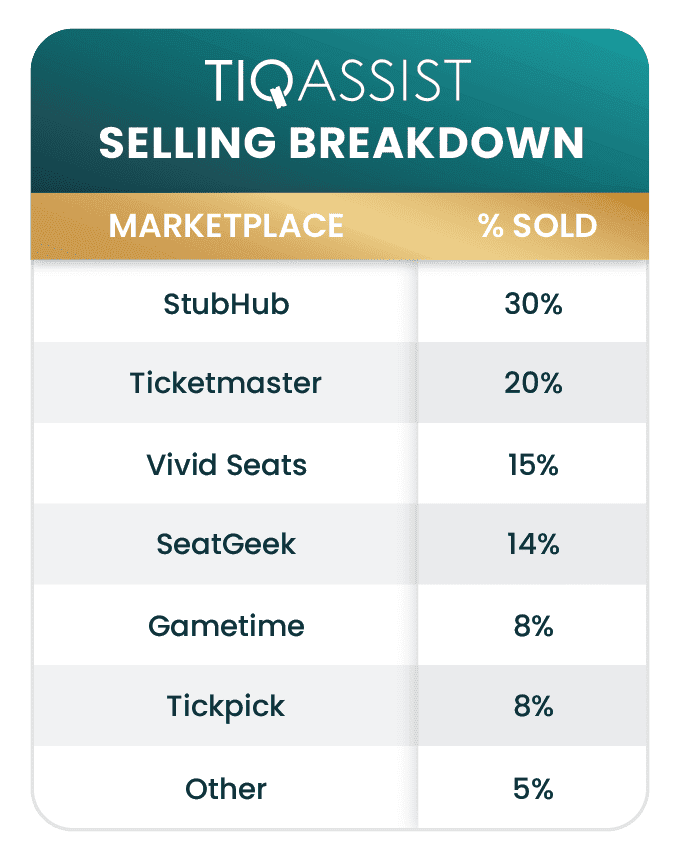
TiqAssist lists tickets on 10+ marketplaces at once to maximize buyer reach for season ticket holders. From selling over $10M in season tickets, these are the marketplaces we’ve sold on the most:
Here’s a quick rundown of why we use some of these resale marketplaces to sell MLB tickets:
Strong buyer loyalty due to a simple buyer experience
Growing brand recognition with buyers and sellers
The bottom line is that with so many options for buyers, listing on just one MLB ticket resale site will only give you exposure to a small fraction of potential buyers. To have your season tickets listed on 10+ marketplaces, sign up for TiqAssist, and we’ll waive our commission on the first listing (third-party fees still apply).
When To Sell MLB Tickets to Maximize Resale Value
Listing as early as possible gives you the best chance of hitting each of the best sales windows. Here are the best times to sell MLB tickets, which inform when we encourage our clients to list:
1. Immediately After the Schedule Release
The best time to sell MLB tickets is immediately after the MLB Schedule Release in August. There are fewer listings to compete against from then until Spring Training, and eager buyers who aren’t as price sensitive.
2. 60+ Days Before the Game
Once the focus shifts to the new MLB, TiqAssist sets and adjusts ticket prices based on the number of days until the game. The most important thing to know is that MLB prices are fairly steady until 60 days before the game, then prices start to drop.
If the game is more than 60 days away: Generally, we keep prices fairly steady.
This is because we have some time to sell MLB tickets for a relatively high price, before prices begin to fall around 60 days before the game.
We do encourage our clients to list at least 90 days in advance of the game, so we have 30 days to market the tickets before prices start dropping.
Once we get to less than 60 days to the game, we systematically drop prices to ensure you don’t experience the downside risks of selling too close to the event.
Your team may outperform expectations, but even then, it’s not worth holding out for that hope. The slim chance of a price rise doesn’t outweigh the risk and higher likelihood of a drop in ticket prices. A winning streak can create modest bumps, and when the market heats up, we adjust prices on remaining games. Still, since MLB prices typically fall in the last 60 days, betting on a big run is usually a losing strategy.
How Season Ticket Holders Can Sell MLB Tickets Strategically
Sellers must understand the difference between “Face Value”, “Resale Value”, and “Listing prices” when selling MLB tickets.
MLB season ticket holders often make an expensive mistake when trying to sell MLB tickets—they believe that resale value should always match or exceed face value. Holding out for face value on the wrong games can lead to selling for pennies on the dollar or giving tickets away for free at the last minute.
What is Face Value?
There are two types of face value that teams provide: “Average Face Value” and “Variable Pricing”. Both are usually determined in the previous MLB season, so they don’t reflect the current resale value.
Average Face Value
Simply what you paid per ticket (total cost ÷ number of tickets). This version of face value is the most problematic when determining resale value, as it doesn’t inform how to sell MLB tickets to individual games or capture how demand varies for each game.
Variable Pricing
Some teams assign different face values for each game based on expected demand. You will see the best game of the season be worth up to 5 times the worst game of the season. For example, playing against the Dodgers on a Saturday will easily be worth 5x more than the game against a bottom-5 team on a Monday or Tuesday.
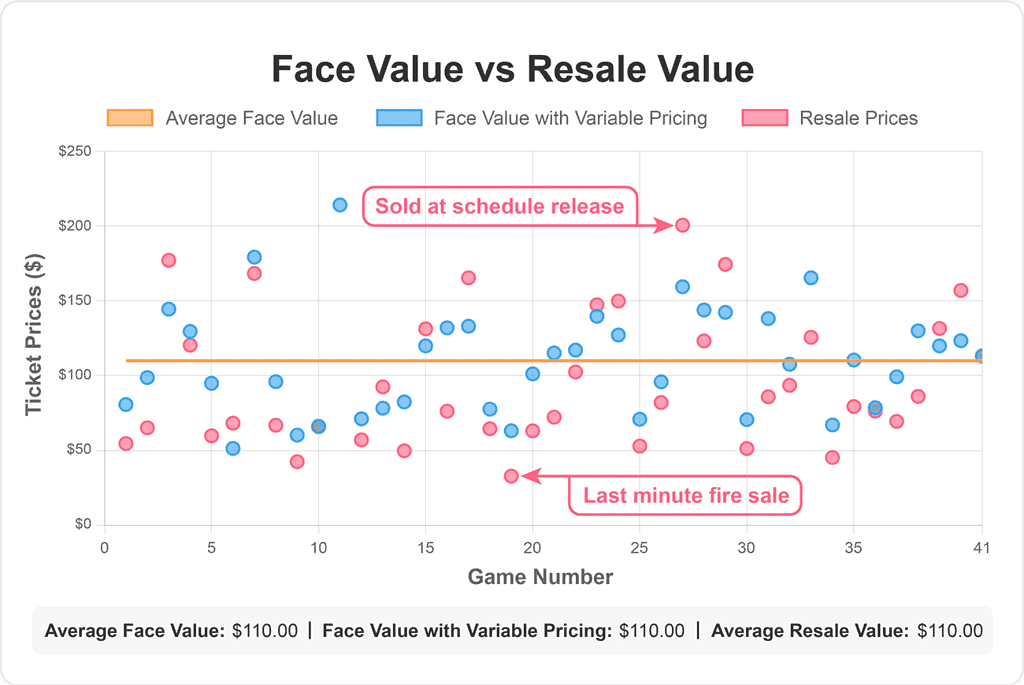
Figures above are illustrative of how face value and variable pricing differ; your team may vary.
What is Resale Value (Market Value)?
Resale value is the most important number to understand when we manage and sell MLB tickets. This is what a buyer would actually pay for your seats right now.
Face Value is a static number usually determined in the previous season, while Resale Value is a real-time number that factors in current ticket supply and demand, key injuries, home and away team performance, and how close to the game you are selling.
For MLB fans, it’s possible for one ticket holder to pay 5x what the person sitting next to them paid! Thats how much resale values can fluctuate over time for the same seats for the same game.
Adding “Resale Value” to the previous chart, you can see that Resale Value has even more variation than Face Value. And if you sell MLB tickets too late, it’s possible the Resale Value is a fraction of Face Value.
Figures above are illustrative of how face value, variable pricing, and resale value generally differ. Your team may vary.
How do TiqAssist’s sales prices differ from the average MLB season ticket holder’s?
Sometimes you’ll get lucky selling on your own by pursuing a higher listing price strategy than TiqAssist.
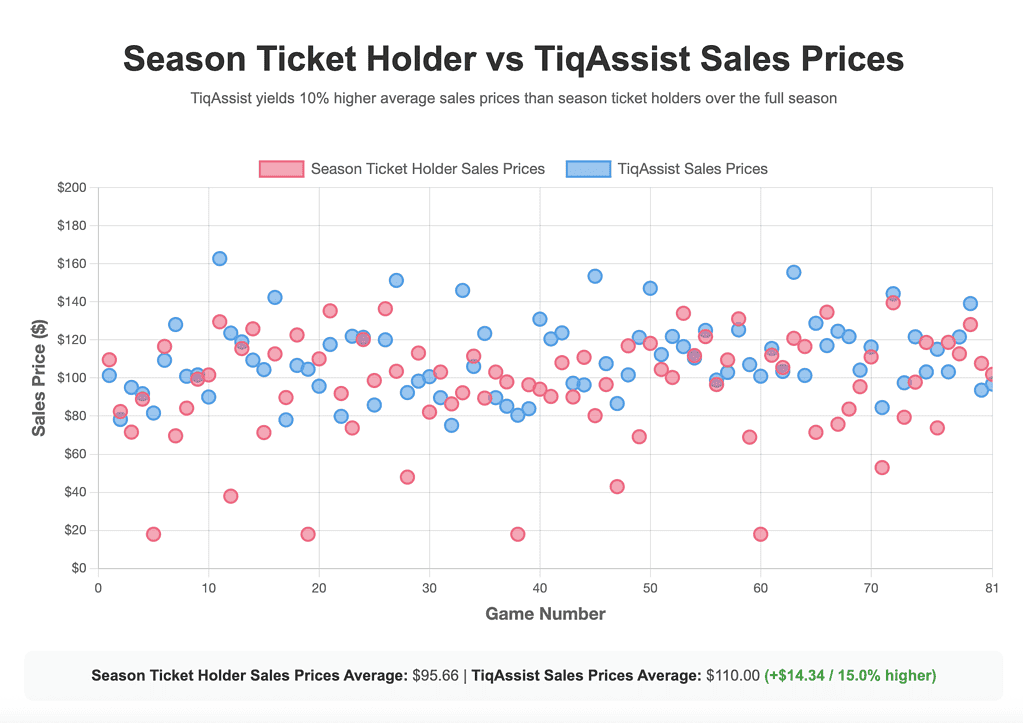
But, with TiqAssist, expect higher sales prices over the full season driven by the following: more consistent sales, way fewer fire sales, along with some “wow!” sales along the way. Thats the power of reaching buyers from 10+ marketplaces, enhanced marketplace pricing data, and the TiqAssist Price Guarantee:
Above chart is illustrative of how sales prices may differ for season ticket holders selling on their own vs. using TiqAssist.
How Relevant are Marketplace Listing Prices?
Many sellers price based on seats they see listed near them, but unsold listings don’t represent the “going rate”—they just show what hasn’t sold yet.
Many listings are overpriced because sellers are hoping to recoup face value when it’s not possible, or haven’t updated prices as the market has dropped. For example, if someone in your section is listing a Tuesday game against the Reds at the average face value, that isn’t illustrative of what the “going rate” today actually is.
Important: The listing prices on every marketplace now include the marketplace buyer fees. You REALLY can’t use marketplace listings prices to sell MLB tickets as the “going rate”, given that buyer fees inflate the listing prices.
Tips to Sell MLB Season Tickets
✅ Think season-long ROI, not game ROI
The most successful MLB season ticket holders treat resale strategically—maximizing revenue across the seasons matters more than breaking even on every single game. The next level is having the great seasons make up for the bad seasons.
✅ Sell premium MLB games strategically
Remember, your season ticket package includes premium games that allow you to sell MLB tickets above face value (playoffs, high-demand matchups) —use those wins to offset games where you’ll sell below cost.
✅ List MLB tickets as early as possible
For most teams, prices drop starting 60 days before the game. Listing early gives you time to test higher prices before the market declines.
✅ Accept current resale value
If resale value is already below face value, your best bet is to accept that fact. Holding out for face value rarely works and usually results in a much bigger loss later.
How Does TiqAssist Sell MLB Season Tickets?
Leveraging TiqAssist’s years of MLB sales and listings data, we’ve built the most accurate ticket pricing model, AMP. Paired with TiqAssist, which allows season ticket holders to sell MLB tickets on 10+ marketplaces to reach up to 5x the buyers, AMP streamlines the process to make MLB season ticket resale simple. The AMP pricing model is currently available for season ticket holders of the following teams:
Pricing is based on more than the listing prices of nearby seats
Most casual sellers price MLB tickets based primarily on the list prices of nearby seats. The problem with relying too heavily on nearby listings when trying to sell MLB tickets is that they tend to be priced inaccurately, for the following reasons:
Many MLB sellers do NOT adjust their prices to the current market.
Many MLB sellers try to recoup face value, even if the true market value is below face.
Listings that are still available on the marketplace, by definition, have not sold. They likely don’t represent the “going rate”.
The best way to sell MLB tickets is to leverage data on all of the stadium’s listings
The AMP pricing model differentiates itself as the best way to sell MLB tickets due to its comprehensive use of past and present data:
Using years of pricing data and millions of data points, AMP calculates the historical price relationship between your seats and every other row
That allows AMP to price each game by leveraging the entire stadium’s pricing data, while reflecting the value of your specific seats. AMP is much more data-driven than just comparing a handful of nearby listings when trying to sell MLB tickets.
AMP Adjusts MLB Ticket Prices Based on “Sell-Through Rate” and “Time to the Event” Data
“Time to Event” Pricing Adjustments:
Tickets listed further in advance of the game will be priced higher by AMP.
As game day nears, if there isn’t a signal that MLB prices will go up, AMP gradually lowers the price to capture buyers before the market dips.
“Sell-Through Rate” Pricing Adjustments:
A key advantage of managing ticket resale for a large volume of MLB season ticket holders is that we get a very strong signal on the strength of the market for every MLB game. AMP can quickly react to buyer demand and pricing trends and adjust on a game-by-game basis.
At the same time, we track the speed of your ticket sales, and AMP fine-tunes pricing to ensure your seats sell at an appropriate pace.
If the rate of sales is slower than we expect → AMP lowers your prices.
If the rate of sales is faster than expected → AMP raises your prices.
How to Sell MLB Tickets- Additional FAQs
Q: What factors impact my ticket prices?
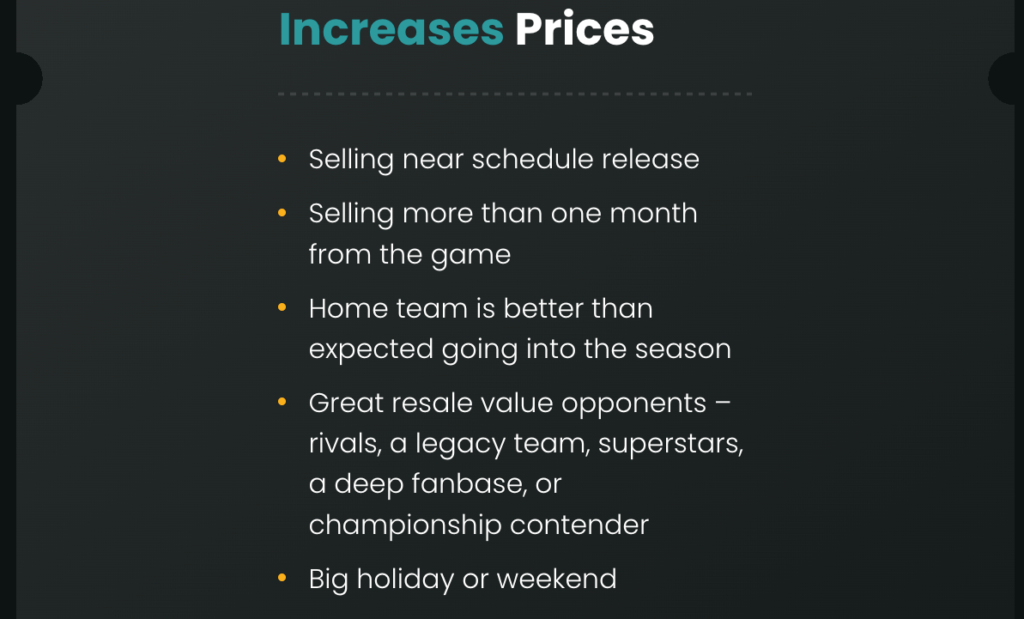
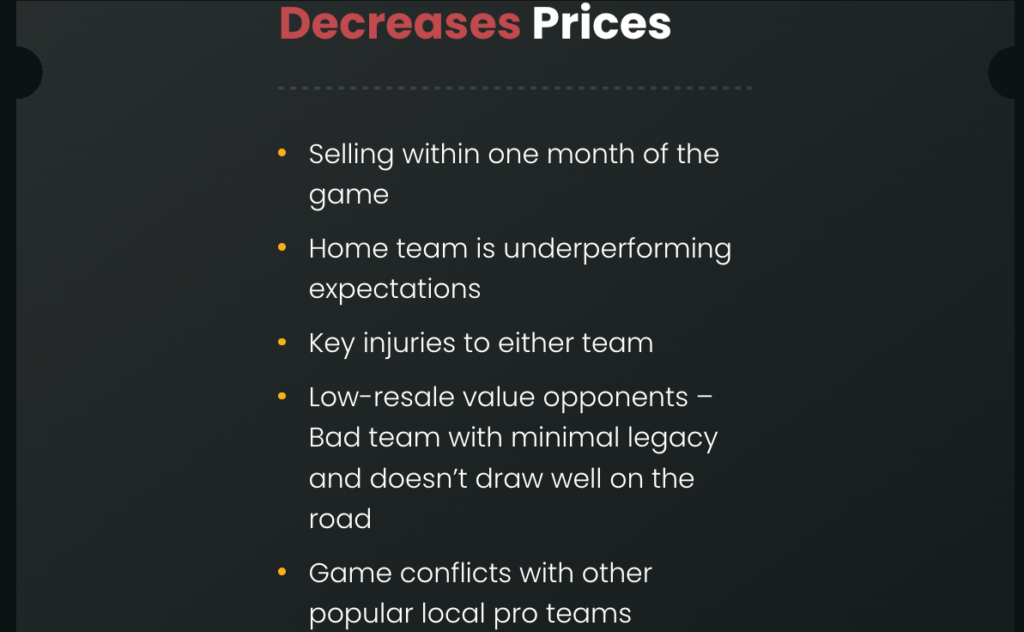
A: Here are some factors that impact MLB ticket prices. We sorted out these factors into negatives and positives to make it easier to decide how to sell MLB tickets.
The positives tend to be already baked into the current resale value, making it difficult for tickets to gain value over time. Many of the negative factors are time-based, and pricing your MLB tickets lower initially to secure a sale can help you avoid these drops.
Q: Why are my MLB tickets not selling?
A: Your MLB tickets may not be selling for reasons such as these
The price they are listed at does not represent their current resale value.
The tickets are listed on a single marketplace, limiting the exposure to a small percentage of buyers.
Season ticket holders can list on TiqAssist to get their seats repriced for them, and broadcasted to 10+ marketplaces with a single tap.
Q: When does the MLB schedule come out?
A: The MLB schedule release occurs in mid-August, with the most recent schedule release taking place on 08/26/2025. Once again, this is the optimal time to sell MLB tickets.
Q: When does the MLB season start?
A: MLB opening night is 03/26/26. Here are some key dates for the MLB season to know when planning to sell MLB tickets:
Friday, February 20: The start of Spring Training.
Wednesday, March 26: MLB Opening Night
Tuesday, July 14: MLB All-Star Game at Citizens Bank Park
Sunday, September 27: The final day of the MLB regular season.
The New Way to Sell MLB Season Tickets
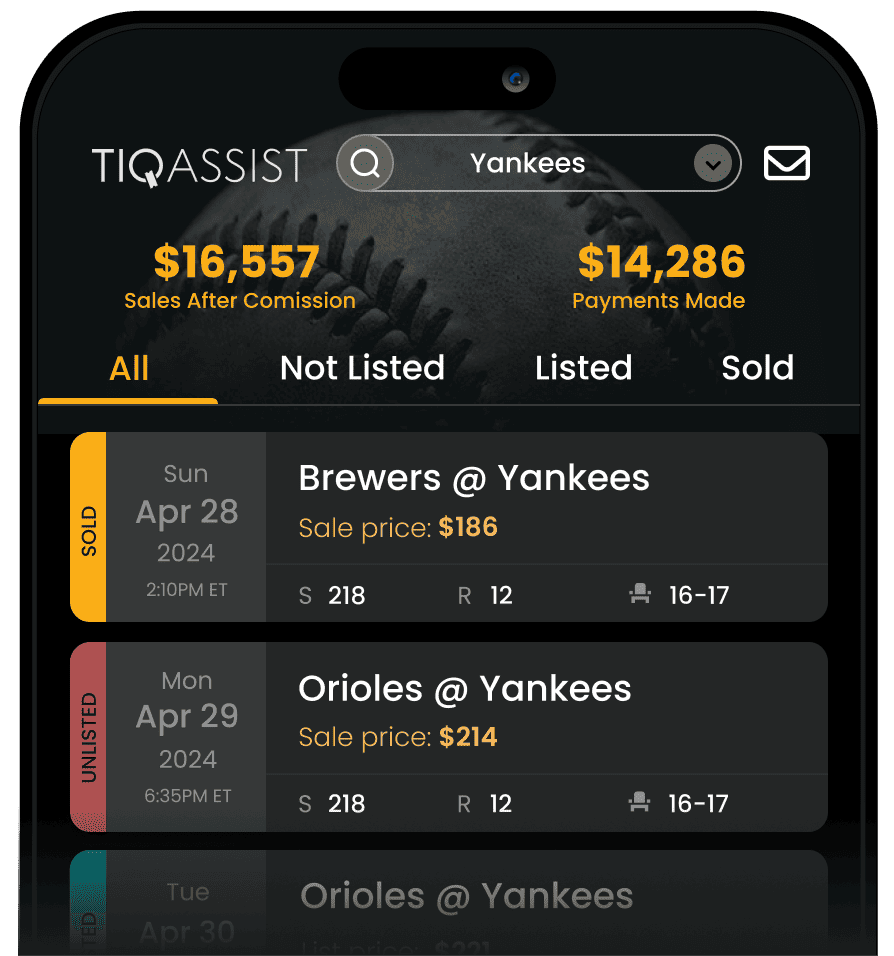
If you ever thought to yourself, “Why do I spend so much time managing my tickets? Why isn’t there a solution for this?” We thought the same thing, so we made TiqAssist.
If you enjoyed this article, you’ll love having TiqAssist’s selling experts and technology fully manage your ticket resale for you. Just click “List” for any game on your personalized dashboard and you’re done!